A new release from an earlier sky
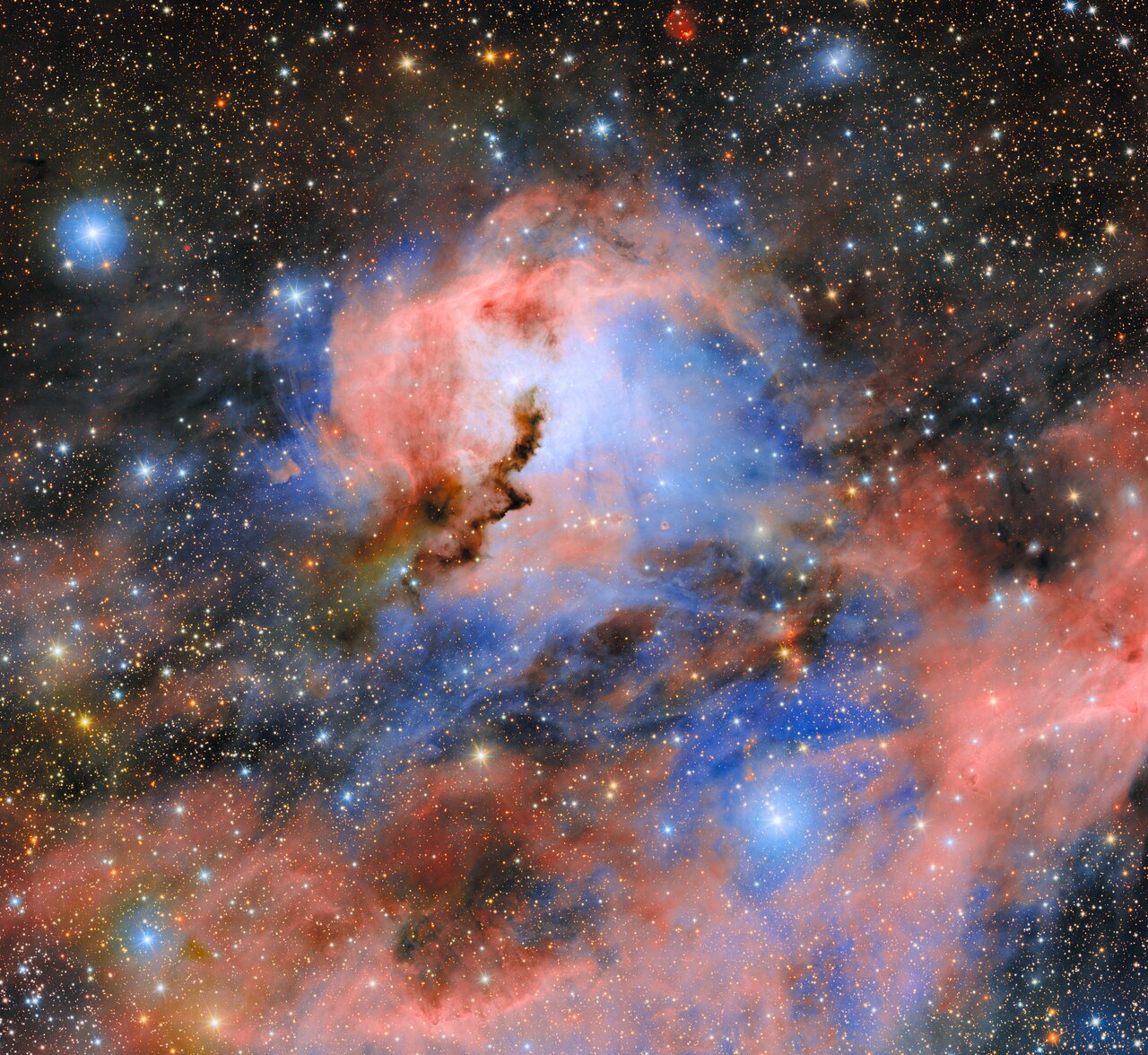
NSF NOIRLab has released a richly detailed view of the head of the Seagull Nebula, a star-forming region roughly 3,700 light-years away. The picture arrived on October 22, but its light was recorded during Rubin Observatory’s engineering campaign in fall 2024.
That distinction is part of the story. These observations helped test the hardware, software and processing methods needed for the observatory’s much larger survey camera. The image is a record of scientific preparation as well as a view of a stellar nursery.
Why the cloud glows
The pink emission traces hydrogen energized by young stars. Blue areas reveal dust reflecting starlight, while darker material cuts a jagged ridge through the bright gas. The region pictured is Sharpless 2-292, within the wider complex associated with IC 2177.
NOIRLab identifies a young, massive triple-star system, HD 53367, near the top of the ridge as the source powering this ionized region. The colors in the published composite help distinguish the gas and dust structures; they are an astronomical image assembled from filtered observations.
The work behind a survey
Rubin’s Commissioning Camera used nine detectors totaling 144 megapixels. Its seven-week engineering campaign acquired about 16,000 exposures. The survey’s LSST Camera is far larger, at about 3,200 megapixels, and covers a much wider patch of sky.
Complex scenes like this gave the image-processing team an early test of how to handle bright nebulosity, fine dust structure and crowded stars together. ComCam has since moved into a supporting role as a test stand. The release illustrates why commissioning data remain useful after an instrument’s main assignment is finished.
behind the story
sources & further reading
- Seagull Nebula through Rubin’s Commissioning Camera
NSF NOIRLab · Observatory release · Accessed Oct 22, 2026
- Seagull Nebula image, filters and credit
NSF NOIRLab · Image record · Accessed Oct 22, 2026
Prepared with AI assistance and checked against the linked sources. This is a synthesis of published material; we did not conduct the underlying research or interview its authors.
Suggest a correction