The interesting object is off to the side
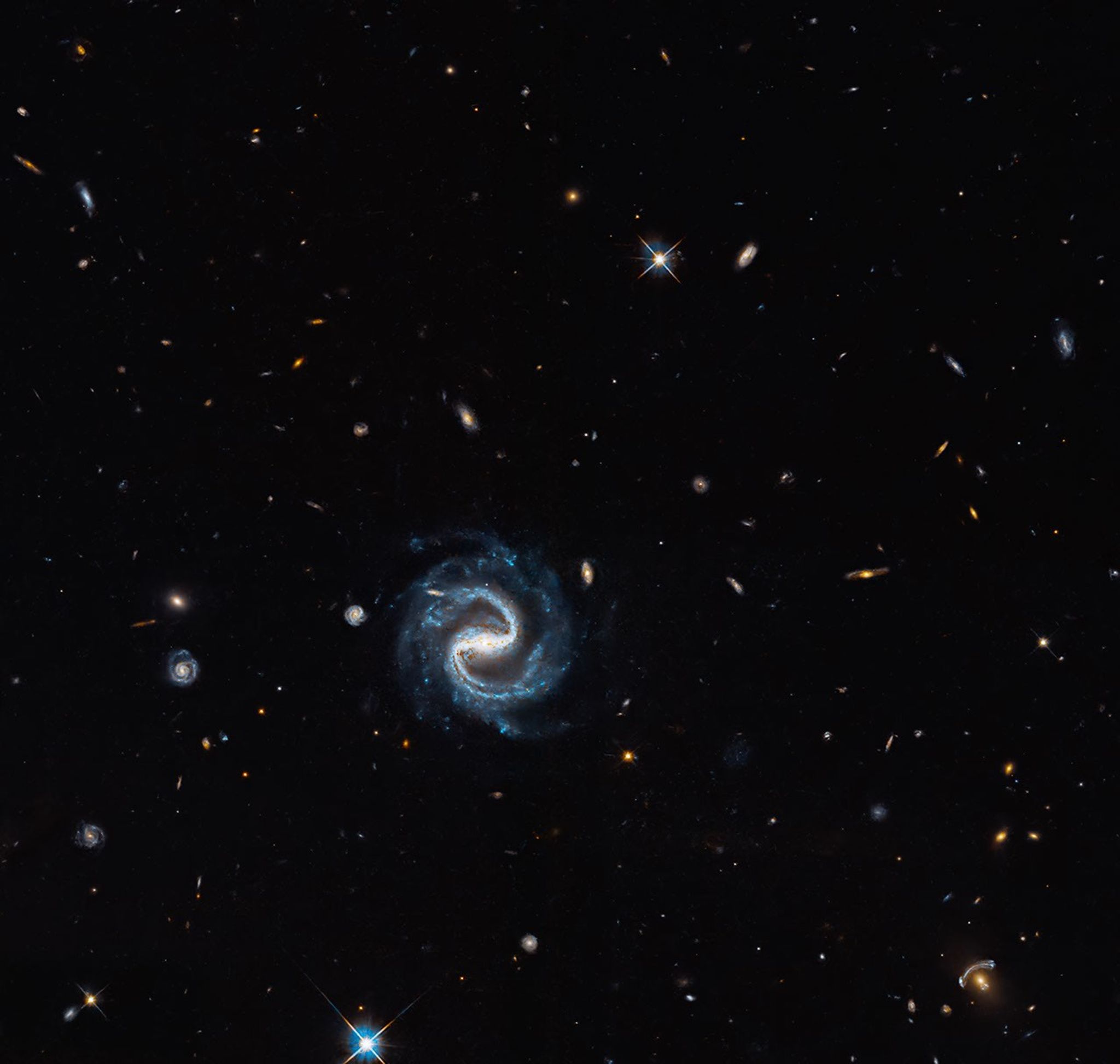
A new Hubble image released by NASA on October 22 contains a prominent barred spiral galaxy. But the feature motivating the observation sits nearby: a foreground elliptical galaxy surrounded by two distorted views of a more distant object.
NASA places the foreground galaxy about 4.5 billion light-years away and the background galaxy about eight billion light-years away. Their chance alignment bends the background light into a large arc and a smaller, flipped counterarc. These are two images of the same background galaxy.
A way to weigh invisible matter
A gravitational lens forms because mass curves spacetime and changes the paths that light follows. The shape and strength of the distortion give astronomers a way to estimate the mass producing it, including material that does not shine.
The inference is made through a model of the lens and the galaxies involved. The visible arc is the observation; the distribution of dark matter is part of the explanation researchers reconstruct from that observation. NASA says these Hubble images are helping build tools for analyzing such distortions.
Detail meets a wider field
Hubble can examine individual lenses in detail. NASA’s Nancy Grace Roman Space Telescope is designed to cover much larger areas of sky, creating an opportunity to find and compare a larger sample of lenses.
The proposed partnership runs in both directions: existing Hubble observations prepare the analysis methods for Roman, and Hubble can follow up on interesting systems Roman identifies. The release describes that scientific groundwork. It does not announce a new measurement resolving the nature of dark matter.
behind the story
sources & further reading
- NASA’s Hubble Charts Path for Roman with Gravitational Lenses
NASA · Mission science release · Accessed Oct 22, 2026
Prepared with AI assistance and checked against the linked sources. This is a synthesis of published material; we did not conduct the underlying research or interview its authors.
Suggest a correction