Turning a line into a swath
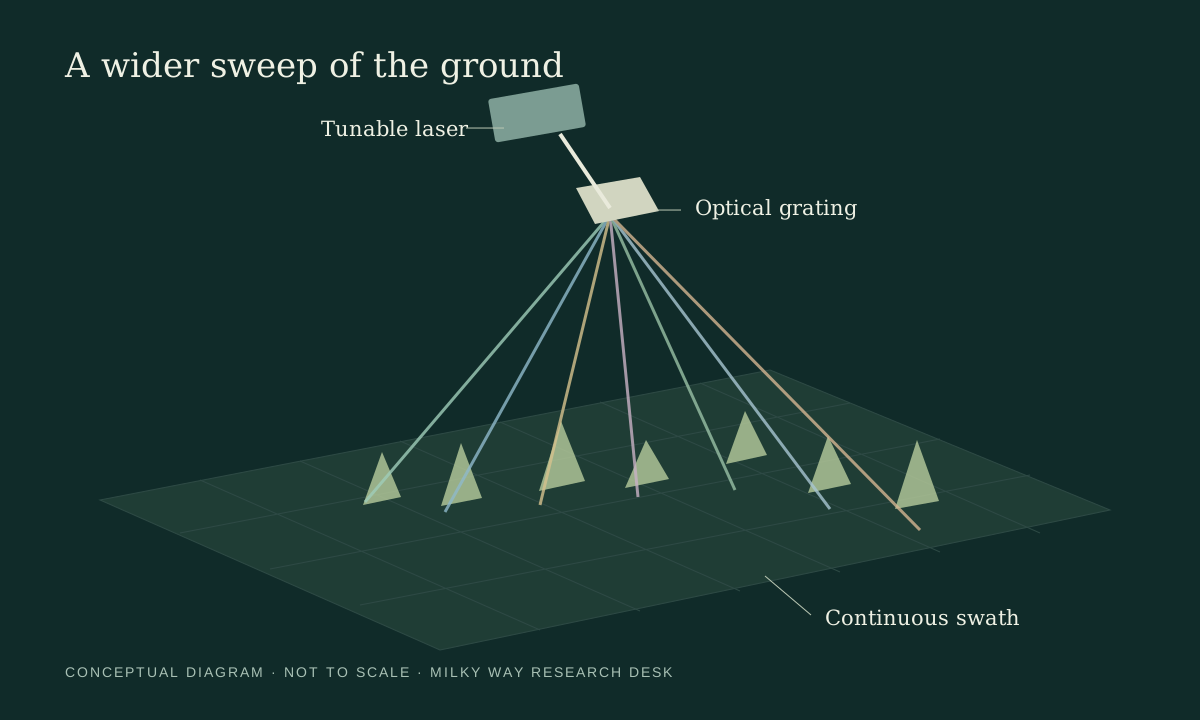
Spaceborne laser instruments can make precise measurements along narrow tracks while leaving substantial areas between those tracks unmeasured. In an October 21 technology report, NASA describes an approach intended to cover more of the ground: steer a pulsed laser by changing its wavelength.
The instrument, called CASALS, sends tunable laser pulses through an optical grating. Different wavelengths are diffracted at different angles, placing measurements across the flight path. The architecture avoids using moving mirrors to perform that steering.
What has actually been tested
NASA reports that an airborne prototype flew on a B200 King Air aircraft in November 2024. From roughly five kilometers above the ground, the instrument achieved a reported horizontal resolution of 22 centimeters, resolving fine vegetation and terrain structure.
The transmitter cycles through 256 wavelengths around 1,040 nanometers. The report also describes a detector quantum efficiency of 80 percent. These are instrument characteristics and campaign results; they should not be read as a guarantee of identical performance from orbit.
The remaining engineering work
The team plans further flights and a wider measurement swath, alongside onboard processing improvements, before developing a space-ready prototype. NASA identifies the ASCENT airborne campaign, scheduled for summer 2027, as a planned next opportunity.
A future orbital instrument would need to demonstrate that the architecture works within spaceflight constraints. The immediate result is therefore a promising airborne mapping method, with a clear development path and substantial qualification work still to do. Its value lies in gathering more continuous measurements of the surface, rather than relying on isolated profiles.
behind the story
sources & further reading
- NASA’s CASALS Instrument Bridges Gaps in 3D Maps of Earth’s Surface
NASA · Technology report · Accessed Oct 22, 2026
Prepared with AI assistance and checked against the linked sources. This is a synthesis of published material; we did not conduct the underlying research or interview its authors.
Suggest a correction